
Shelf Sort Coming soon tothe App Store
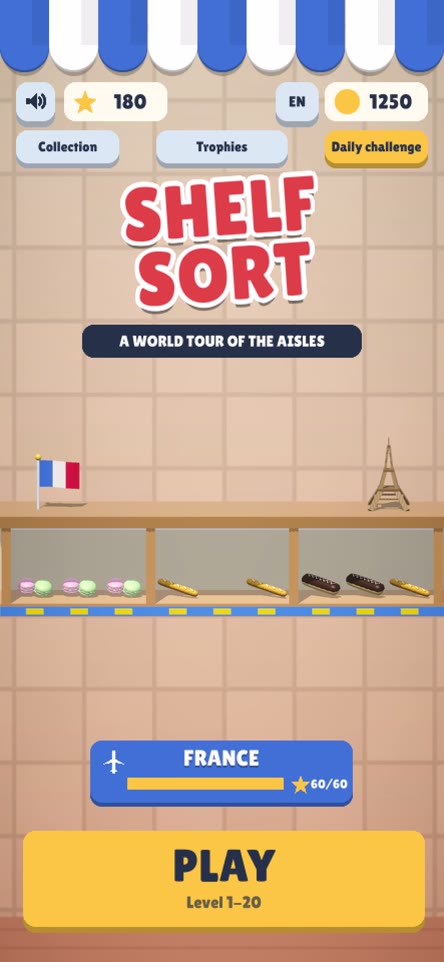
My iPhone game, in App Store review: drag goods between the shelves and line up 3 identical items to clear the aisles, from Paris to New York.
- A full game, not a prototype: 80 levels across 4 countries (France, Italy, Japan, USA), a 3D world map, a daily challenge, a sticker album and trophies.
- Every level is solvable: levels are generated and checked ahead of time by a tool (LevelBaker). 3 stars based on moves, time left and bonus use.
- A new twist in each country: frozen goods, mystery boxes, crates, padlocks, golden goods, pigeons.
- Monetization and data: AdMob rewarded ads (GDPR consent and Apple's tracking prompt), level funnel and ad events in GameAnalytics.
- Shipping: iOS builds in Unity Build Automation with automatic TestFlight upload, App Store listing in English and French, screenshots and preview video.
- 3 video ads made from the real game: an in-editor Unity tool replays hand-written levels with a fake finger, slow motion, zoom and an end card, then films them at 1080×1920 with Unity Recorder, identical on every take. Three angles to test: the satisfying combo, the fail that makes you want to fix it, the variety of obstacles.
Epic Plane Evolution
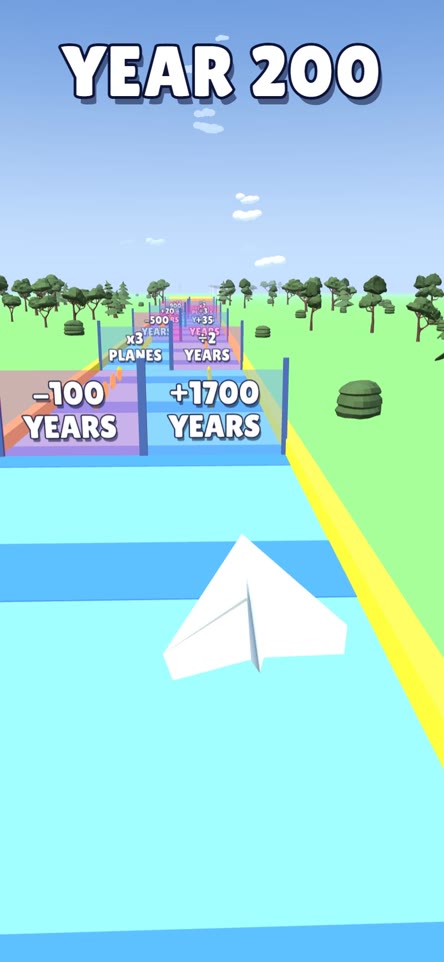
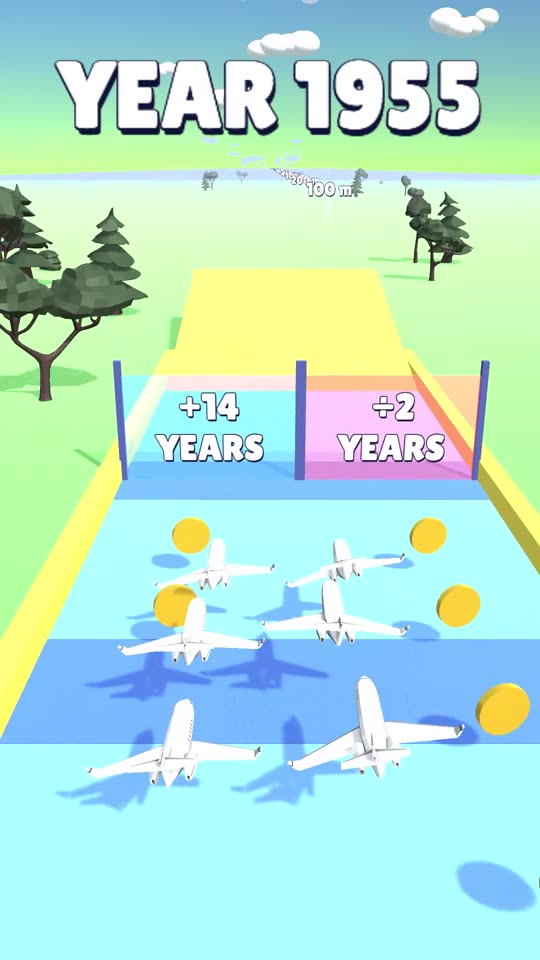
A hyper-casual concept and 3 video ads to test it: fly through the right gates to evolve your plane, from a paper plane to a rocket, then launch off the ramp as far as you can.
- 3 creative hypotheses, one per ad. A: the ridiculous fail ("never pick the red gates"). B: the spectacular win, from paper all the way to space. C: so close, then it all falls apart, the frustration that makes you want to play.
- What I would measure: click-through rate, cost per install and view retention (3 s, end of video), then iterate on the hook of the winning ad.
- The takes are recorded in Unity (Unity Recorder) with a scripted autopilot that plays like a human: it hesitates, grabs coins and swerves into the wrong gate at the last moment.
- Playable ad: the same level as a single 1.3 MB HTML file (three.js), ready for ad networks (MRAID): tutorial hand, 20 seconds of play, end card with a "Play Now" button. The full Unity prototype is still playable.
- My role: concept, game design, ad direction and every iteration (camera, pacing, fake-outs, text readability). Code and ad editing were produced faster with AI, under my direction: specs, in-game testing, fixes and decisions at every iteration.
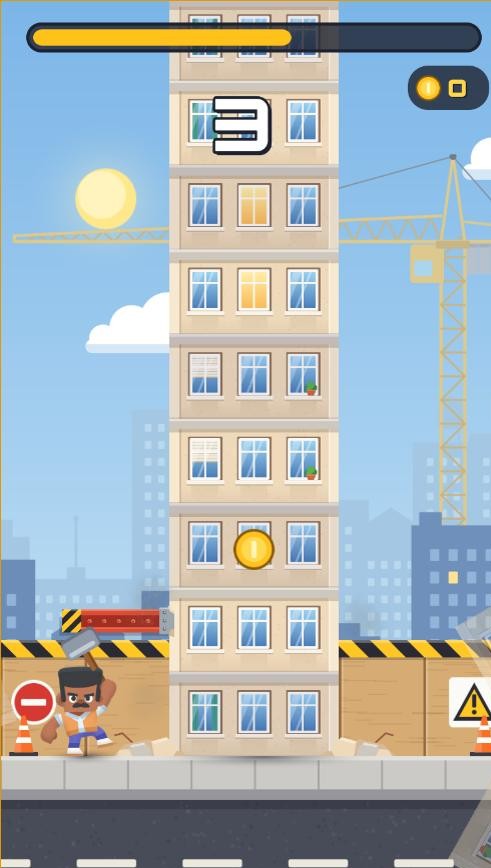
Demolition Buster
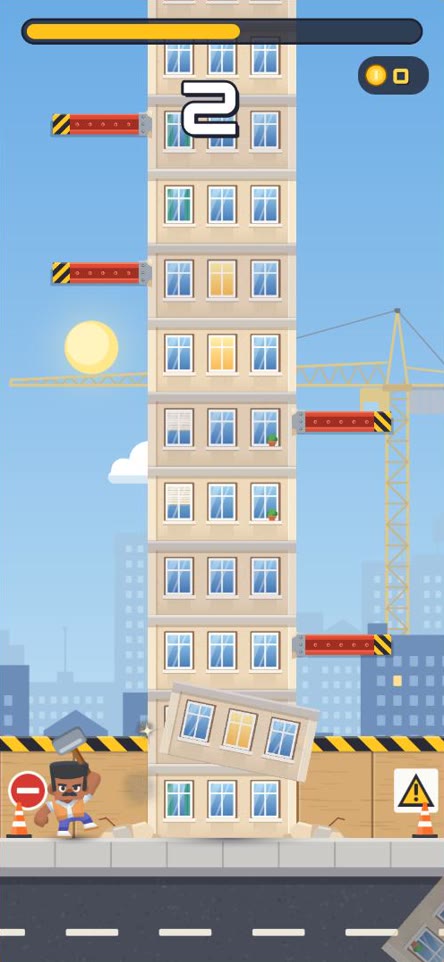
An endless tower, one hammer: tap left or right to smash the bottom floor without getting crushed by the beams.
- Game rules in pure C#, in an assembly with no Unity reference → testable and deterministic.
- 38 EditMode tests + end-to-end PlayMode tests, including a 5,000-floor simulation proving the tower is always playable.
- Meta progression: coins, a shop with 4 breakers, saves that survive corrupted data.
- "Continue" via rewarded ad (simulated), once per run: the ad SDK hook is isolated.
- Milestones every 50 floors: the facades change color, with a jingle and vibration.
- Difficulty, timer and shop tunable in ScriptableObjects, without touching code.
- Procedural juice: ballistic debris, squash, screen shake, score pop, sounds synthesized in code.
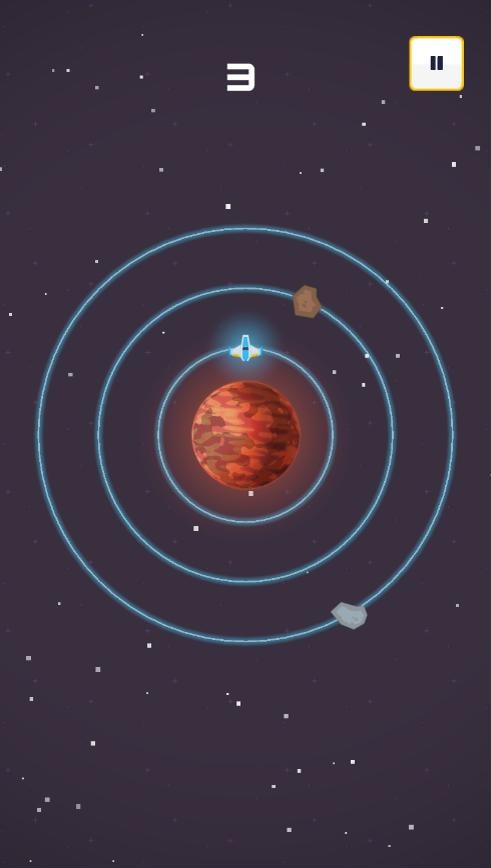
Orbit Dash
One tap = switch orbit around the sun. Leave your ring at the last moment to chain near misses into combos.
- My twist: the near miss. Leaving a ring less than 0.35 s before an asteroid gives a bonus, and chaining them builds a combo (rising pitch, particles, popup). The survival game becomes a risk-taking game.
- Explicit state machine (Menu / Game / Pause / Game Over).
- Systems decoupled with C# events: sound, shake, particles and haptics react without knowing each other.
- Difficulty curve, rings and obstacles in ScriptableObjects.
- Custom object pool, safe area, WebGL/Android builds from the command line.
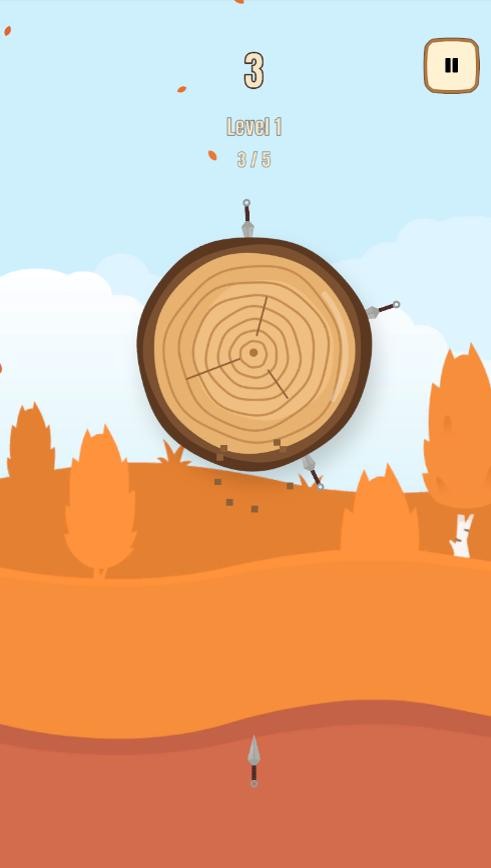
Timber Strike
Throw knives into a spinning log without hitting the ones already stuck in it. Every 5 logs, a boss reverses direction mid-spin.
- My twist: boss logs. Their speed follows a sine wave: they slow down, stop and spin back the other way. You have to read the rhythm, not just the position.
- Collision is pure angle math, no physics: precise and free performance-wise.
- Knife shop: apples you hit carry over between runs and unlock skins (kunai, pencil, paper plane, axe, hammer). Meta loop: play, earn, unlock, replay.
- Level progression, persistent high score.
- "Lumberjack workshop" art direction: central palette, UI fully generated in code.
- Procedurally generated log and knife sprites.
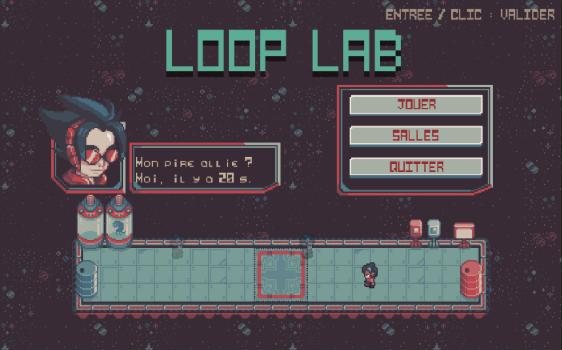
Loop Lab
You have 30 seconds. When the loop restarts, your past attempts become clones that help you solve the level.
- Deterministic recording / replay on the physics tick: player and clones read the same clock.
- Up to 4 clones at once, pressure plates, doors, lasers and security cameras.
- Levels described as ASCII grids and built by an editor tool.
- Saved progress: rooms stay locked until the previous one is cleared, "Play" resumes where you left off.
- Custom pixel font and UI (text rendering, UI factory); graphics from a pixel art pack.
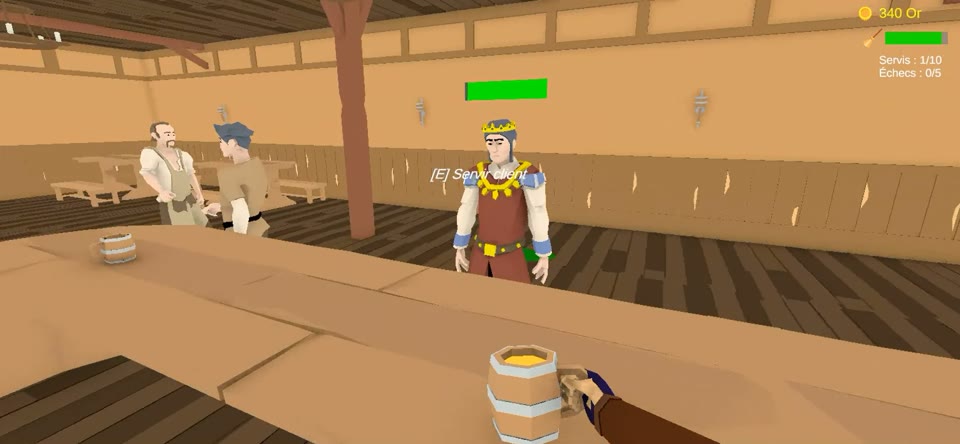
Order Up: Tavern
3D management game: run a tavern, serve customers and keep the business going.
- Made solo, from concept to release on itch.io: a complete, playable game loop.
- Modular gameplay systems: customer AI, economy, physical interactions.
- The whole visual pipeline: level design, lighting, VFX integration.
- All editor work done by hand: scenes, objects, components and scripts wired onto objects, colliders, Animator.
- 3D character rigged (skeleton) and animated myself in Blender, e.g. the sweeping motion, then brought into Unity.